School History
History of Scoil Naomh Íde
The word education comes from the Latin meaning to draw out or to go from the unknown to the known. Scoil Naomh Íde has good reason to be proud of its education heritage. It has followed the excellent tradition of schooling started in early Christian times by St. Ita. Our school has taken its name from St. Ita.
Education in Ireland declined due to various invasions by the Vikings, the Normans and the involvement of the English government in Irish affairs after the dissolution of the monasteries by King Henry VIII in 1536. This involvement was unacceptable to the Irish people. In 1695 the Irish Parliament passed the Penal Laws. Catholics were not allowed to participate in the parliament in Dublin. These laws were meant to keep the Catholic population in Ireland in poverty and ignorance and Catholics were forbidden from receiving an education. It was at this time that Hedge Schools became popular. Education in Ireland went underground. In 1824 it was recorded that there were 10 such schools in the then larger parish of Killeedy. The “schools” were mostly hovels, mud cabins, barns and some were, literally, under hedges. In 1831 the government set up The Board of Commissioners of National Education in Ireland. Grants were given for the setting up of local schools under a patron, usually the local parish priest. Proselytism was to be strictly banned. The local community was to provide one third of the cost of the building.
The first application for a grant for a school in Ashford seems to have been made on the 17 th April 1841. A school building was already in existence at this time. It was made of clay, had a thatched roof and its condition was described as “not good”. It was also not “wholly used for the use of the children.” It had been erected with private funds and the family who erected it also used it as a residence. The building contained 12 foot desks and two tables 3 foot long. The teacher was 21 year old Andrew Cregan. He had received no formal instruction on how to teach. School opened at 8am and closed at 5pm in the summer and opened at 10am and closed at 4pm in winter.
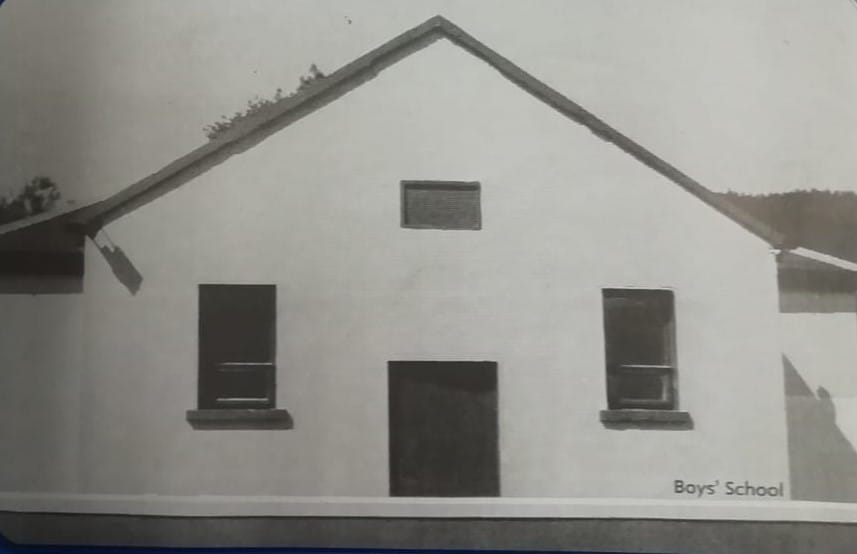
In 1846 permission was granted for a one room building measuring 20 feet by 36 feet for 120 children, with privies and furniture. For one reason or another no progress was made on the building by 1854 and the grants were cancelled. The Rev. H. Fitzgibbon, to whom the grants had been made, was by now deceased and his successor, Rev. R. Scott, wanted to choose an alternative site. A further grant application was made in May 1855 and this time work was commenced. The new school building was opened in May 1858 on land given by the Cregan family of Ashford. By 1910 an extension was “badly needed”. The estate of the local landlord G.E.S. Maunsell proposed the site of the disused Protestant church near Ashford as a site for the extension to the school. The Board of Commissioners was unable to provide funding for the extension at that time. In 1931 the site of a former R.I.C. hut on the western end of the village and which had been burnt by the Black and Tans in the War of Independence was opened as the new Girl’s National School. The Boy’s School continued to be accommodated in the original building in the village.

The Boy’s School and the Girl’s School were amalgamated on July 1st 1968. Both schools operated together as Scoil Naomh Íde with 4 teachers at its peak until numbers decreased and the Girl’s School now accommodates the highly successful Glenquin Ashford Montessori Pre-School.
On Friday 13th June 2008 the school community celebrated the 150th year of continuous education in the original 1858 building. There are few schools in Ireland who can make such a claim. While the original post famine building footprint remains the same the building has been upgraded and modernised at various stages throughout the now 165 years. We hope that future generations will be inspired by the spirit of those who have gone before them.
Reference: Cill Íde Book